
Award-winning reference photos
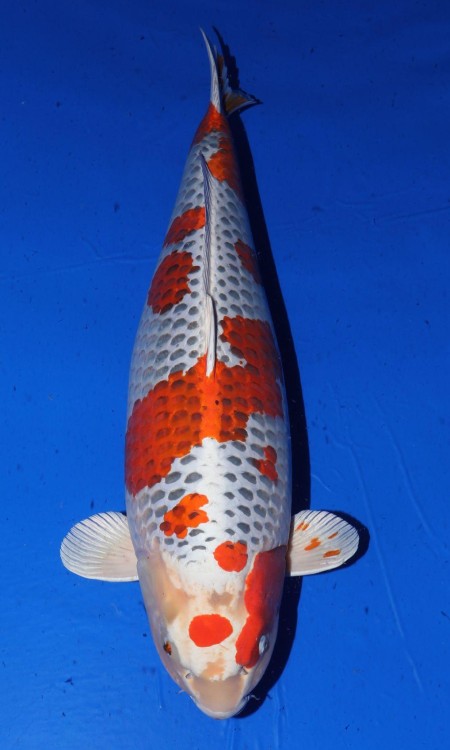
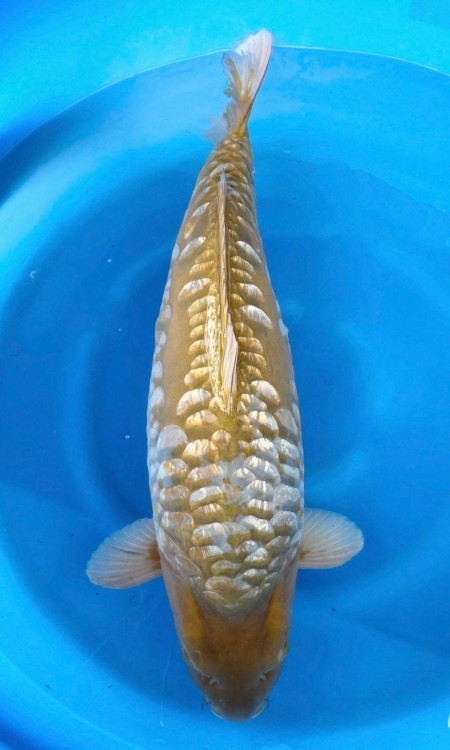
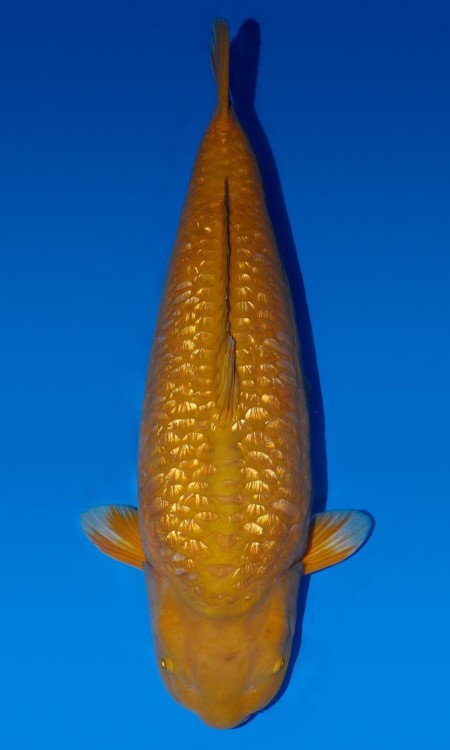
How to identify Gin Rin
- Individual scales reflect light like glass, pearl, or diamond flakes.
- The effect should be visible in rows across the body, not just a few random scales.
- Gin Rin may appear on Kohaku, Showa, Chagoi, and many other varieties.
Quality points
- Sparkle should be even and strong from shoulder toward tail.
- Body and underlying variety quality still come first.
- Avoid fish where the shine is patchy or distracts from weak conformation.
How the official groups fit together
JAS uses A-Ginrin for shining-scale Gosanke—Kohaku, Taisho Sanke, and Showa—and B-Ginrin for shining-scale koi outside those three. These are classification groups; the fish still retains its underlying variety.
- Diamond Ginrin: the strongest, bright reflective effect.
- Pearl Ginrin: a round gold or silver highlight appears near the center of each affected scale.
Verified Gin Rin combinations
The underlying variety name still matters. JAS examples show how Gin Rin can be layered over both Gosanke and non-Gosanke koi.
| Official group | Verified examples | Identification order |
|---|---|---|
| A-Ginrin | Gin Rin Kohaku, Gin Rin Taisho Sanke, Gin Rin Showa Sanshoku | Identify the Gosanke base pattern first, then confirm orderly reflective scales. |
| B-Ginrin — reticulated and patterned | Gin Rin Goshiki, Gin Rin Asagi, Gin Rin Kujaku, Gin Rin Ochiba | Keep the base variety’s ground, reticulation, color and metallic cues separate from the Gin Rin sparkle. |
| B-Ginrin — Koromo family | Gin Rin Ai-goromo, Gin Rin Budo-goromo | Look for Koromo edging within the red pattern, then confirm gold or silver reflective scales. |
| B-Ginrin — other examples | Gin Rin Shiro Utsuri, Gin Rin Kumonryu, Gin Rin Chagoi, Gin Rin Soragoi, Gin Rin Karashigoi | Do not treat “Gin Rin” as the fish’s complete variety name. |
Strong sunlight can make ordinary metallic skin or wet scales look sparkly in a photograph. Check whether the reflection belongs to individual scales in repeated rows, then separately assess any whole-body Hikari luster.
Common comparison
Compare Gin Rin with metallic Hikari. Gin Rin shine comes from individual scales; Hikari luster is a metallic sheen across the skin and fins. A koi can combine modifiers, so identify each trait separately.
| Look first at | Good sign | Beginner caution |
|---|---|---|
| Body | Balanced frame, smooth swimming, no deformity. | Do not let rare color hide weak conformation. |
| Skin and color | Clean, readable, and consistent for the variety. | Muddy color usually becomes more distracting with size. |
| Scale or luster trait | Even rows, sparkle, reticulation, or metallic quality depending on the group. | Random patches, dull fins, or broken scale rows reduce impression. |
Sources
This page follows the official JAS distinction between A-Ginrin and B-Ginrin. Each fish retains its underlying variety while Gin Rin describes its reflective scales; reference photographs are credited individually above.