
Award-winning reference photos
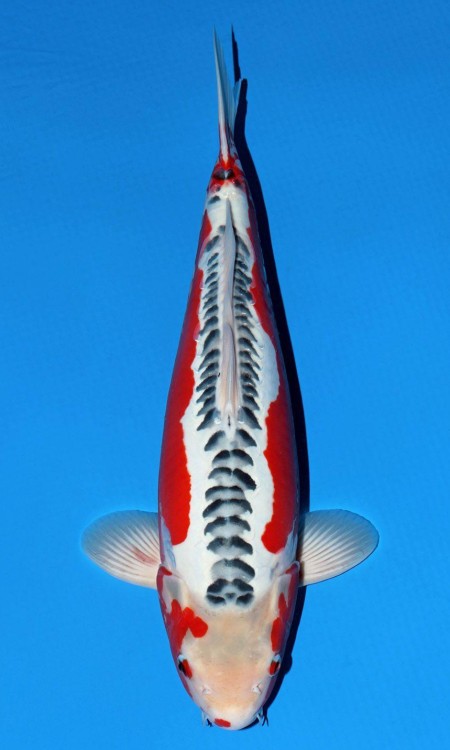
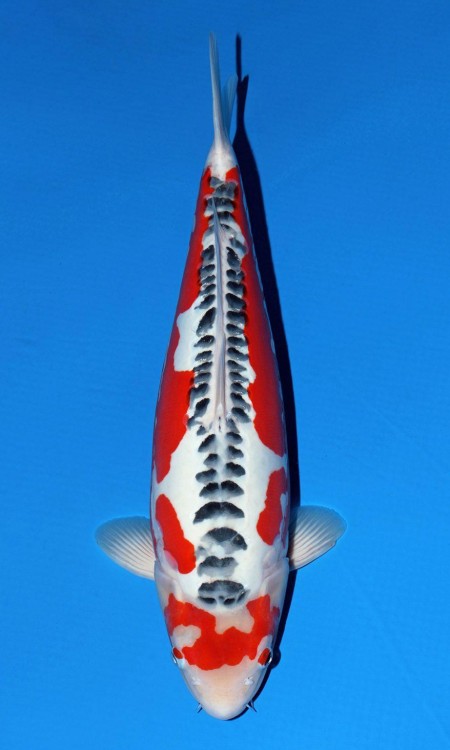
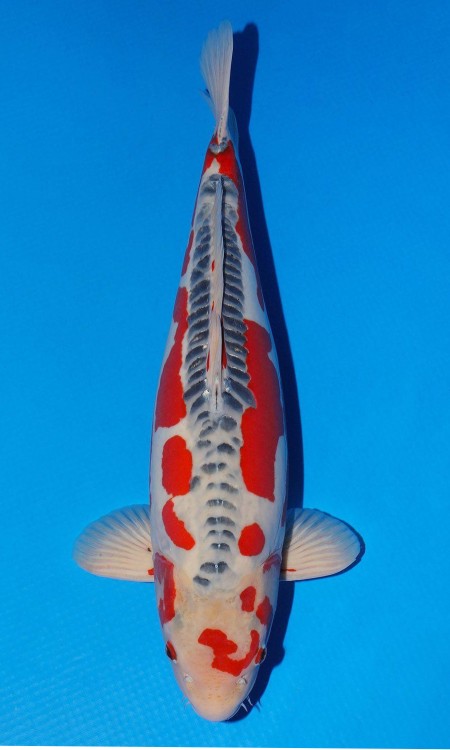
How to identify Shusui
- Smooth Doitsu body rather than fully scaled skin.
- Large mirror scales, called Onigoke in Japan, should form a neat line along the back.
- Red should be balanced on the belly, fins, and both cheeks without overwhelming the blue ground.
Quality points
- A clean, clear head is especially important; dark cloudiness weakens the overall impression.
- The dorsal scales should be well aligned and uniform in size, not broken or scattered.
- The blue ground and red accents should feel controlled rather than muddy.
Common comparison
Compare Shusui with Asagi first. Shusui originated from a cross between Asagi and Doitsugoi: Asagi is fully scaled with netted reticulation, while Shusui expresses the related blue-and-red color idea on a Doitsu body.
Shusui variations and related types
- Hana Shusui
- Red markings run between the dorsal scale row and the lateral scale line.
- Hi Shusui
- The red rises farther across the back while the Shusui structure remains visible.
- Ki Shusui
- A yellow Shusui that still shows blue or indigo ground. A yellow Doitsu koi with no indigo ground and black dorsal scales belongs more naturally with Doitsu Ki Matsuba.
- Pearl Shusui
- Ginrin-like shine appears in the large dorsal scales.
- Ginsui and Kinsui
- Metallic Shusui-related koi shown in the Hikari-moyomono class under ZNA classification.
Family name does not always decide the show class
Competition classification can differ from visual ancestry. Under Zen Nippon Airinkai rules, Shusui Sanshoku, Shusui Showa, and Goshiki Shusui are entered as Kawarimono, while Ginsui and Kinsui are entered as Hikari-moyomono. Confirm the current rules of the specific show before entering a fish.
| Look first at | Good sign | Beginner caution |
|---|---|---|
| Body | Balanced frame, smooth swimming, no deformity. | Do not let rare color hide weak conformation. |
| Skin and color | Clean, readable, and consistent for the variety. | Muddy color usually becomes more distracting with size. |
| Scale or luster trait | Even rows, sparkle, reticulation, or metallic quality depending on the group. | Random patches, dull fins, or broken scale rows reduce impression. |
Reference
Identification and quality points are based on the All Japan Nishikigoi Promotion Association's Shusui guide. Variation names and show-class notes follow the Zen Nippon Airinkai Shusui reference. Photo sources are listed with each image.