
Award-winning reference photos
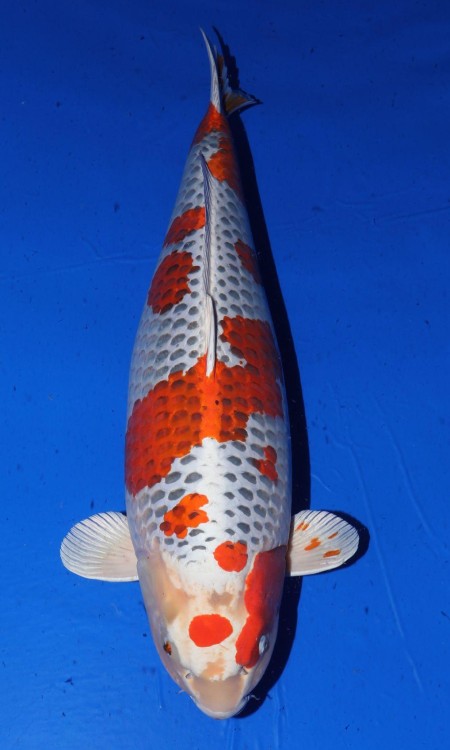
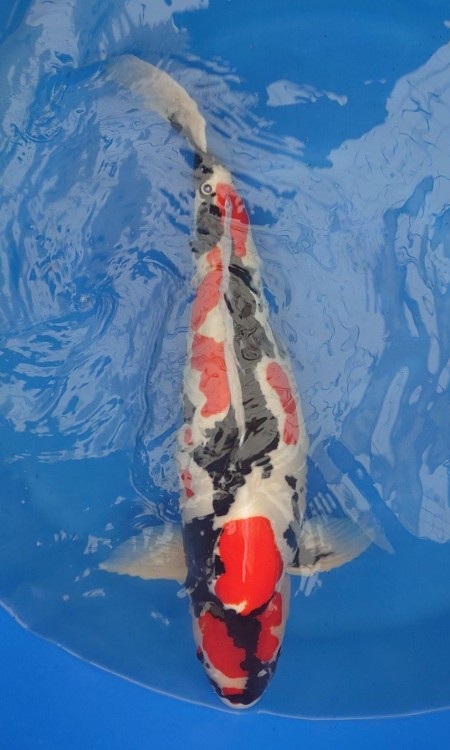
How to identify Goromo / Koromo
- White base and red pattern often resemble Kohaku structure.
- Dark edging appears over or within the red markings rather than as Sanke-style sumi.
- Ai Goromo tends toward blue edging; Budo Goromo can look more grape-purple.
Quality points
- The white ground should stay clean so the reticulation does not make the fish look dirty.
- The overlay should enhance the beni, not blur the pattern edge.
- Body and skin quality still matter more than novelty.
Common comparison
Do not confuse Goromo with Sanke. Sanke has separate black markings; Goromo has a netted or shaded effect associated with the red pattern.
Koromo or Goshiki: where is the mesh?
The JAS Koromo definition describes blue or black, crescent-shaped coloring at the tips of scales within the red markings. The white ground lacks the Asagi-ji mesh found in Goshiki. This location is more useful than simply asking whether the fish looks dark.
Ai-goromo has indigo edging on its red-pattern scales. Budo-goromo has reddish-brown markings with a dark, grape-cluster appearance. These descriptions should not be reduced to a single overall color seen in a photograph.
Recognized Koromo family forms
Koromo is a family rather than one fixed color layout. The underlying pattern tells you which name applies; the indigo or black crescent edging on the red scales supplies the Koromo character.
| Form | What to look for | Do not confuse it with |
|---|---|---|
| Ai-goromo | White body with red markings; indigo appears in half-moon shapes at the tips of scales within the red. | Goshiki, whose Asagi-type mesh extends onto the ground rather than staying confined to the red pattern. |
| Budo-goromo | Reddish-brown markings carry dark, grape-cluster-like patterning. | A fish that merely has muddy or uneven red; the pattern should remain readable. |
| Koromo-sanshoku | Taisho Sanshoku structure, plus indigo half-moons on scales inside the red markings. | Ordinary Sanke: separate sumi alone does not make a fish Koromo. |
| Koromo-showa | Showa Sanshoku structure, plus indigo half-moons on scales inside the red markings. | Ordinary Showa or Goshiki Showa; first identify the base pattern and where the reticulation sits. |
| Doitsu-koromo-showa | A nearly scaleless Doitsu body showing Koromo-showa characteristics. | A separate base variety: Doitsu describes scale type, while Koromo-showa describes the color-pattern family. |
| Shunrai | White body with red markings; black half-moons may appear on the red scales or across the dorsal surface. | Ai-goromo, where the official description centers on indigo edging within the red markings. |
Use the whole fish for identification. A dark photograph, developing sumi, or one isolated scale is not enough to assign a subtype confidently.
Definition: All Japan Nishikigoi Promotion Association — JAS Koromo.
| Look first at | Good sign | Beginner caution |
|---|---|---|
| Body | Balanced frame, smooth swimming, no deformity. | Do not let rare color hide weak conformation. |
| Skin and color | Clean, readable, and consistent for the variety. | Muddy color usually becomes more distracting with size. |
| Scale or luster trait | Even rows, sparkle, reticulation, or metallic quality depending on the group. | Random patches, dull fins, or broken scale rows reduce impression. |
Sources
Names and distinguishing features on this page follow the All Japan Nishikigoi Promotion Association Koromo definitions. Reference photographs are credited individually above.