
Award-winning reference photos
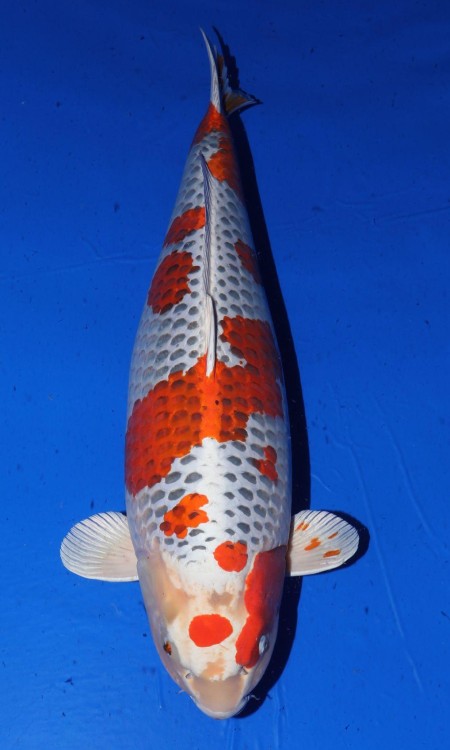
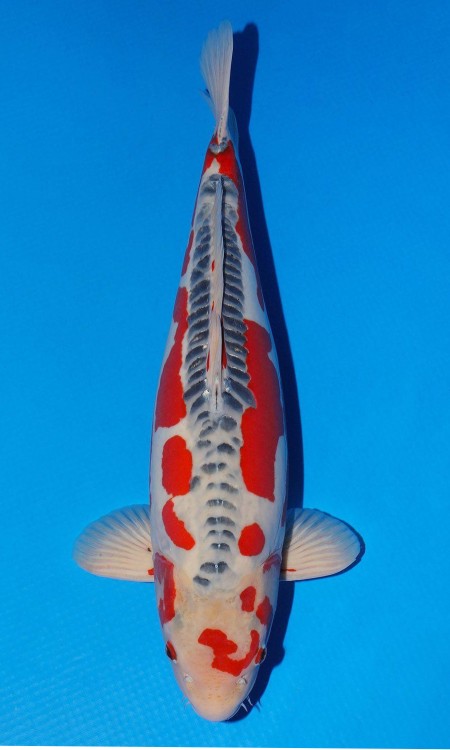
How to identify Goshiki
- Often shows Kohaku-like red over a darker netted base.
- The ground may range from light gray to deep charcoal depending on bloodline and development.
- The impression should be layered, not simply dirty.
Quality points
- Red should remain bright and readable against the dark ground.
- Reticulation should look intentional and even.
- Avoid examples where all colors blur into a muddy surface.
Common comparison
Look for Asagi-ji: a blue or indigo, mesh-like ground formed by the scale arrangement across the back. Counting five visible colors is not a reliable identification test.
In Koromo, the blue or black edging is associated with the red-pattern scales; the white ground does not have Asagi-ji. Kujaku combines an Asagi-like mesh and red pattern with whole-body metallic luster. Compare the location of the mesh first, then check the luster.
| Similar koi | Decisive clue | What can mislead you |
|---|---|---|
| Goshiki | Asagi-type reticulation extends across the back and ground. | The name does not require five clearly countable colors. |
| Koromo | The white ground lacks Asagi-ji; indigo or black forms half-moon edging mainly on red scales. | Dark edging on red can look like Goshiki in a close crop. |
| Kujaku | Reticulation and red pattern are combined with whole-body metallic luster. | Strong lighting can make an ordinary wet scale look metallic. |
Confirmed Goshiki-related types
- Goshiki-sanshoku
- Combines the appearance of Taisho Sanke with an Asagi-type ground pattern.
- Goshiki-showa
- Combines the appearance of Showa Sanshoku with an Asagi-type ground pattern.
- Mameshibori Goshiki and Kuro Goshiki
- These are recognized names, but a fixed color ratio or reticulation threshold is not part of the cited JAS definition. Use the names cautiously when identifying a fish.
Definition: All Japan Nishikigoi Promotion Association — JAS Goshiki.
| Look first at | Good sign | Beginner caution |
|---|---|---|
| Body | Balanced frame, smooth swimming, no deformity. | Do not let rare color hide weak conformation. |
| Skin and color | Clean, readable, and consistent for the variety. | Muddy color usually becomes more distracting with size. |
| Scale or luster trait | Even rows, sparkle, reticulation, or metallic quality depending on the group. | Random patches, dull fins, or broken scale rows reduce impression. |
References
Definitions and comparison points follow the JNPA references for Goshiki and Koromo. Photo sources are listed with each image.