
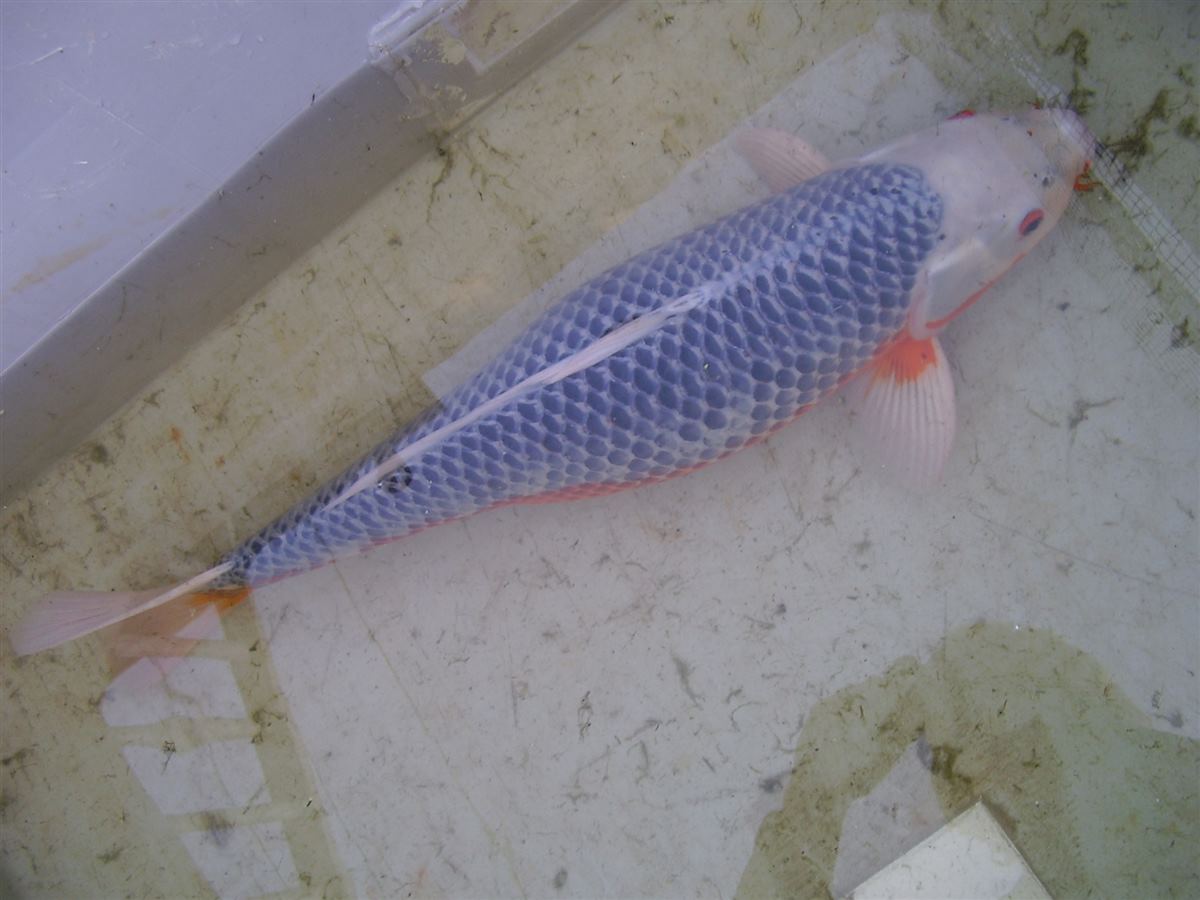
What to look for in Asagi
In the Japanese JAS terminology standard, the Asagi definition describes a blue, net-patterned ground with belly red as a general characteristic. For appreciation, the All Japan Nishikigoi Promotion Association points to the clarity of the head, the evenness of the scale pattern and the balance of the red markings.
| Feature | What to look for | How to check |
|---|---|---|
| Head | A clear, light head, which can be white or amber-toned. | View the head from above in even light. |
| Scale pattern | A blue net pattern with an even rhythm across the back. | Follow the rows from the shoulders toward the tail. |
| Red markings (hi) | Red often appears on the belly, cheeks and fins. Some fish carry more red. | Compare both flanks and see how the red sits against the blue back. |
| Body shape | A balanced outline from the shoulders to the tail base. | Assess the silhouette as the fish swims. |
Asagi or Shusui?
Shusui was developed by crossing Asagi with Doitsu carp. Shusui typically has large scales along the dorsal line and mostly bare flanks. Asagi has small scales across the back that form a broad net pattern.
Traditional Asagi names
Zen Nippon Airinkai describes these names in its Asagi references. The English and Japanese guides use different names for the deeper-blue entry.
| Name | Visible feature |
|---|---|
| Gunjo Asagi | The name used for the clear indigo type in the English guide. |
| Narumi Asagi | Darker scale centers and lighter edges make the net pattern distinct. |
| Taki Asagi | A white band separates the blue ground from the red. |
| Mizu Asagi | A pale blue form also called Akebi Asagi. |
The English guide also traces Aka Matsuba, Ki Matsuba and Kigoi to the Gunjo line. For show entries, consult the organizer’s rules.
Award-winning Asagi examples


A first look from above
- Start with the blue scale pattern across the back.
- Compare the head and the two flanks in similar light.
- Check whether the scales cover the back or cluster in a row along the dorsal line.