
What makes a Kujaku?
The JAS koi terminology standard describes Kujaku by its Asagi-type ground, red markings on the back and shine across the body. The All Japan Nishikigoi Promotion Association also calls it Kujaku Ogon. In the fully scaled form, look for the net-like scale pattern across the back.
Fully scaled and Doitsu Kujaku side by side
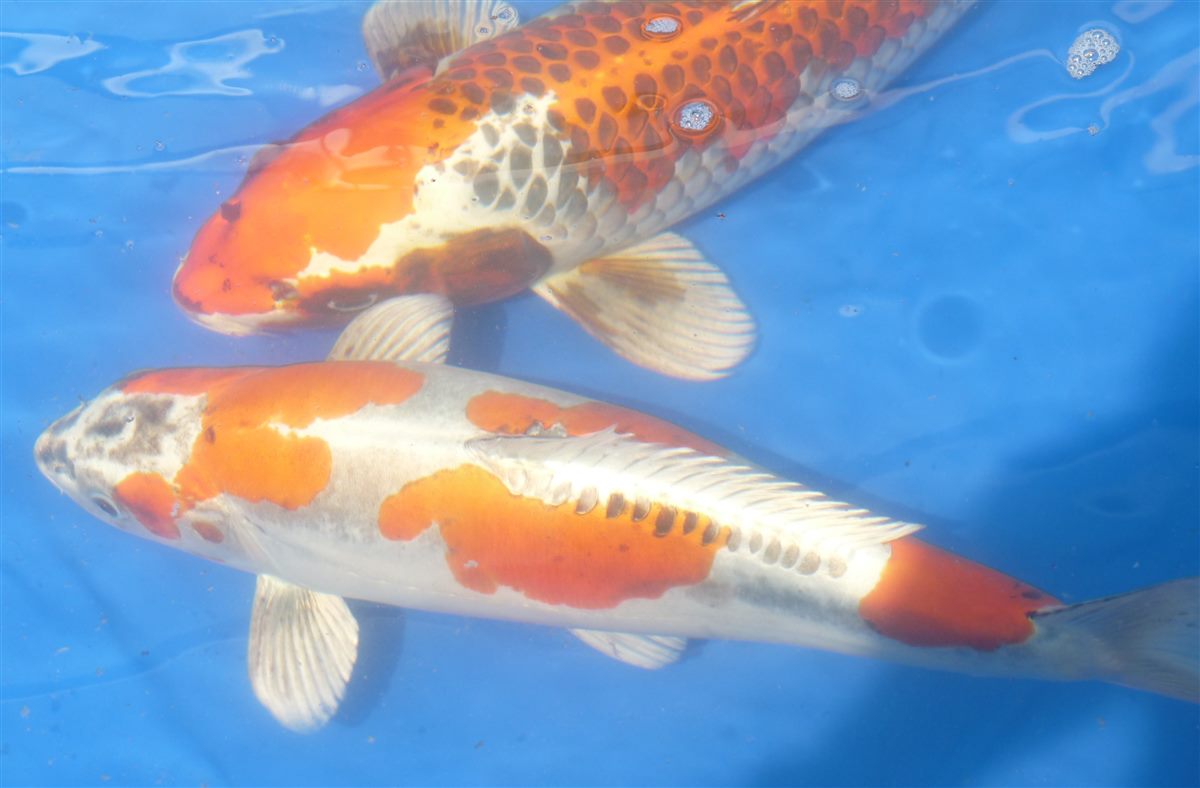
Three features to check
- Metallic sheen. Look at the head, body and fins under even light. The sheen extends across the fish.
- Scale pattern. On a fully scaled fish, follow the rows from shoulder to tail. Dark scale centers and lighter edges make the net pattern visible.
- Red or orange markings. Look for distinct patches on the back. Compare how the markings and scale pattern read together.
Kujaku and similar-looking koi
| Variety or trait | What to look for |
|---|---|
| Ogon | Metallic and generally single-colored. Matsuba Ogon may show a dark scale pattern, so also look for distinct red or orange patches on the back. |
| Goshiki | Can have a net-like ground and red markings. Whole-body metallic sheen is a defining feature of Kujaku. |
| Ginrin | Individual reflective scales flash. Check the head and fins to assess whether the fish has a whole-body metallic sheen. |
| Doitsu Kujaku | Much of the skin is exposed, with fewer scales. Look at the metallic sheen, red markings and placement of the remaining scales. |
Why Doitsu Kujaku looks different
A Doitsu Kujaku retains the metallic sheen and markings of Kujaku with greatly reduced scale coverage. A continuous mesh over the back is an identification cue for the fully scaled form. On a Doitsu fish, compare the exposed skin and the rows of scales that remain.
What to look for when choosing a Kujaku
- Start with body shape and balance while the fish swims.
- Compare the shine on the head and fins with the rest of the body.
- On a fully scaled fish, look for a regular net pattern and red or orange markings that are easy to distinguish.
Show classes can vary by organizer. The 13th International Junior Koi Show, for example, listed Kujaku separately from Hikari Moyo. Consult the rules for the event you plan to enter.