
How to identify Goshiki
The Japanese standard JAS 0020 describes a blue to indigo ground with a net pattern formed by the scales across the back, excluding the head. The red patches may show some blue or indigo, and some fish also have black markings. The name means “five colors.” The scale pattern and where it sits are better clues than a color count.
Two Goshiki examples
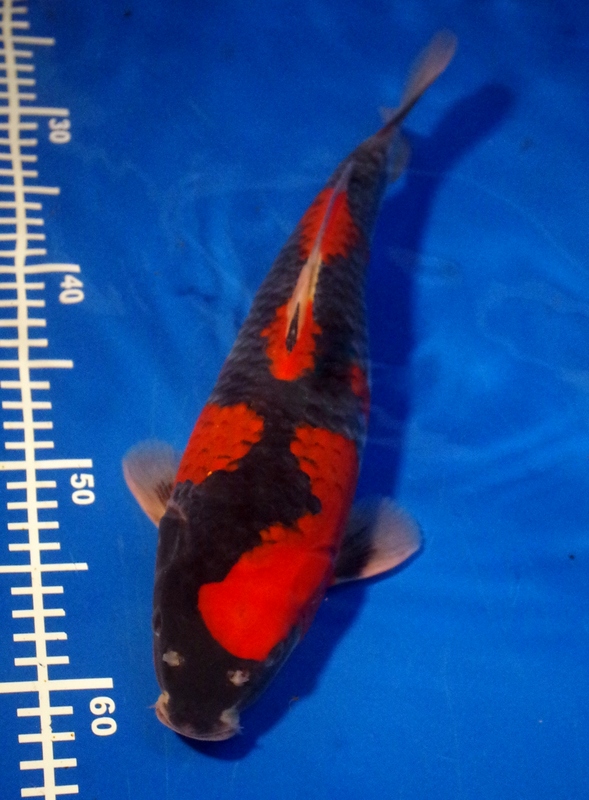

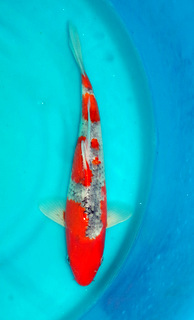

Goshiki, Koromo and Kujaku compared
| Variety | Where to look |
|---|---|
| Goshiki Koi | The net pattern runs across the ground of the back, between the red patches. |
| Koromo (Goromo) | Look for blue or black edging on the scales within the red patches. The white ground lacks the Asagi-like net pattern. |
| Kujaku | Look for whole-body metallic luster alongside the reticulation and red markings. Check the head and fins as well as the back. |
What to look for when choosing a Goshiki
Start with a balanced body and steady swimming. In even light, look for a regular net pattern and clear contrast between the ground and the red. A reflection from a wet scale can look metallic in a photo, so look at the fish from more than one angle.
Names you may see
The All Japan Nishikigoi Promotion Association lists Mameshibori Goshiki and Kuro Goshiki among the names in use. Goshiki-sanshoku and Goshiki-showa combine an Asagi-like ground with the appearance of Taisho Sanke and Showa, respectively. The two photos show individual fish and illustrate the terms used by the photographer.